
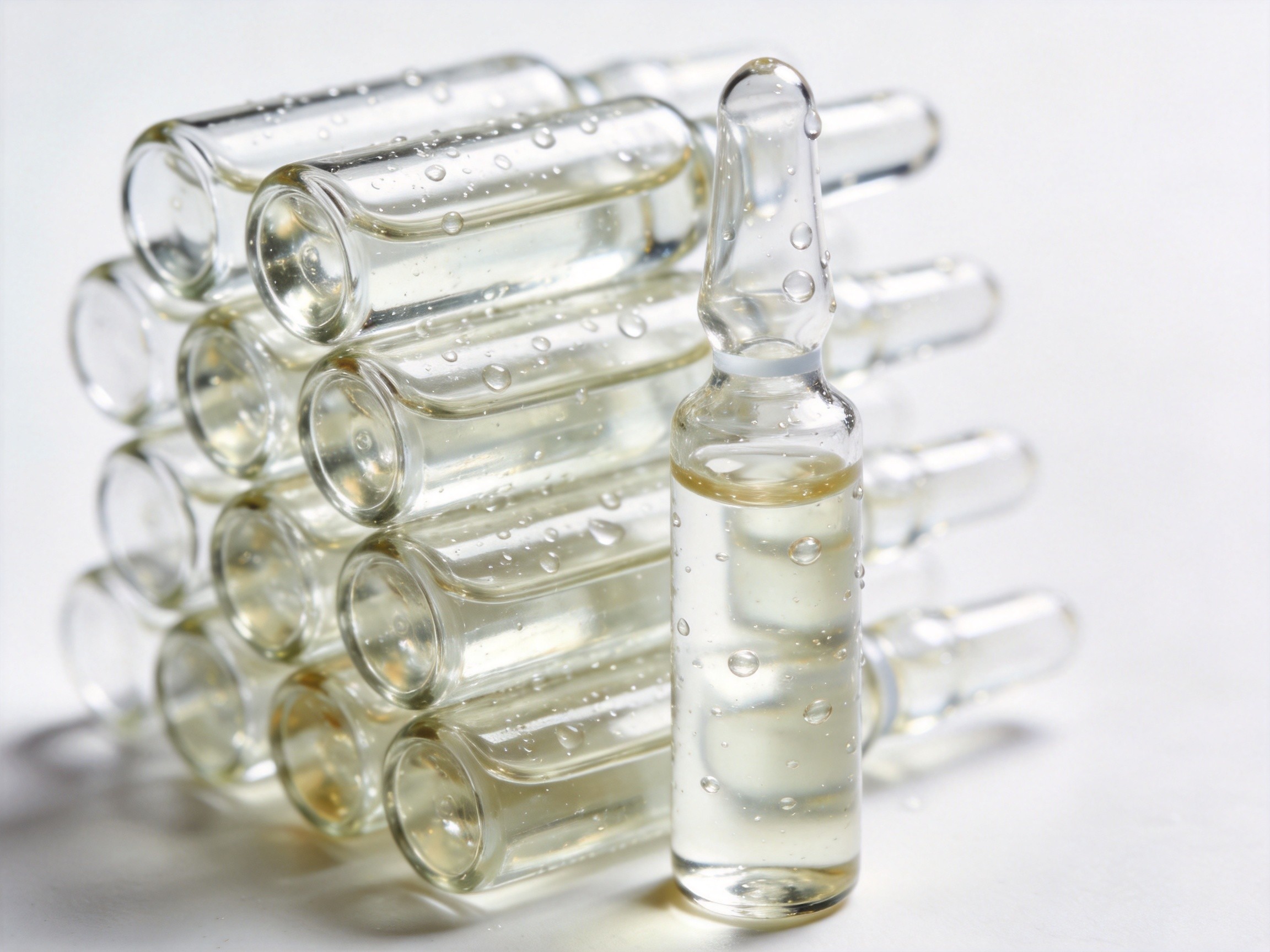
If your private-label buyers are asking about "peptide serums," they almost always mean one of three ingredients: Acetyl Hexapeptide-8 (the expression-line peptide sold under the trade name Argireline), Palmitoyl Pentapeptide-4 (the collagen-signaling peptide sold under the trade name Matrixyl), or Copper Tripeptide-1 (the blue copper carrier peptide, GHK-Cu).
This guide explains what each one actually is, how the peptides differ from one another, what use levels and formats are realistic, how they must be named on the label, and where the cosmetic compliance line sits. It is written for brand owners, importers, and product managers who want to build a credible peptide line rather than a "peptide complex" sticker.
The 30-second answer
A cosmetic peptide is a short synthetic chain of amino acids used as a biological signal on skin. The peptides you will actually meet on ingredient lists fall into a few working classes:
• Acetyl Hexapeptide-8 is a neurotransmitter-signaling peptide. It modestly softens the appearance of dynamic expression lines (forehead, crow's feet, between the brows) with continued use. It is not an injected neuromodulator and does not paralyze muscle.
• Palmitoyl Pentapeptide-4 is a signal peptide (a "matrikine"). It tells fibroblasts to support the look of collagen, firmness, and smoothness over weeks.
• Copper Tripeptide-1 is a carrier peptide that delivers a buffered trace of copper, used for the appearance of remodeling, firmness, and post-treatment recovery. It carries a natural blue-green color and has specific formulation rules.
All three are topical cosmetic ingredients. They work gently and gradually, are largely limited by how well they cross the stratum corneum, and must be described with appearance language. A finished product often combines two classes, but the label must name the actual INCI ingredients rather than a generic "peptide complex."
Why brands should care about peptides in 2026
Peptides are one of the few anti-aging categories where the marketing story and the underlying biochemistry genuinely overlap. Unlike a trend built on a single viral post, these ingredients have been in cosmetic commerce for more than twenty years: Acetyl Hexapeptide-8 has been used since 2001, Palmitoyl Pentapeptide-4 since the early 2000s, and the GHK copper complex was first described in the 1970s.
Consumer interest has accelerated sharply as short-form video positioned Acetyl Hexapeptide-8 as an at-home, needle-free option for expression lines. That visibility is an opportunity for an export brand, but it is also a compliance risk: the more a product is marketed as a "Botox alternative," the closer it gets to claims a topical cosmetic cannot legally make. The winning products lean on the science, position the benefit as modest and gradual, and avoid injection or paralysis language entirely.
The four working classes of cosmetic peptides
The most widely cited way to organize topical peptides (popularized in cosmetic-dermatology reviews) divides them by their primary mechanism. Understanding these classes matters because they do different jobs and are not interchangeable.
| Class | What it does | Best-known example | INCI name | | --- | --- | --- | --- | | Signal peptides | Tell fibroblasts to support collagen and matrix | Matrixyl | Palmitoyl Pentapeptide-4 | | Carrier peptides | Deliver a trace element (usually copper) | GHK-Cu | Copper Tripeptide-1 | | Neurotransmitter-signaling peptides | Soften the appearance of expression lines | Argireline | Acetyl Hexapeptide-8 | | Enzyme-inhibitor peptides | Reduce the breakdown of matrix proteins | Soy/rice peptides | various |
Many finished peptides act through more than one pathway, and a well-designed serum will deliberately combine a signal peptide with a carrier or a neurotransmitter-signaling peptide. But a product that lists only "peptide complex" with no named sequence tells the buyer nothing about which class they are purchasing — and it is a common way to underdose an expensive ingredient while charging a premium.
Acetyl Hexapeptide-8: the expression-line peptide
What it is. Acetyl Hexapeptide-8 is a synthetic chain of six amino acids with the sequence Ac-Glu-Glu-Met-Gln-Arg-Arg-NH2. It was developed by Lipotec (now part of Lubrizol) and sold under the trade name Argireline. It has a molecular weight of roughly 889 Da and is fully water-soluble. Older labels and literature sometimes call it Acetyl Hexapeptide-3; the two names refer to the same molecule, and the correct current INCI name is Acetyl Hexapeptide-8.
How it is described to work. The sequence mimics a short fragment of SNAP-25, one of the proteins that forms the SNARE complex responsible for releasing the neurotransmitter acetylcholine at the nerve-to-muscle junction. By competing for a position in that complex, the peptide is described as modestly reducing the efficiency of neurotransmitter release, which attenuates the intensity of the small facial contractions that etch dynamic lines. The effect is reversible and wears off when use stops; the peptide has no enzymatic activity and does not cleave proteins.
Why it is not an injection. An injected botulinum-toxin product is a prescription treatment that physically reaches the muscle and enzymatically blocks the signal for months. Acetyl Hexapeptide-8 is a topical cosmetic that does not reach the muscle, is far milder, and produces only a gradual softening of the appearance of lines. Independent penetration studies have found that only a very small fraction of an applied dose even crosses the stratum corneum, with most of the dose remaining on the surface. No cosmetic should be described as a replacement for, or equivalent to, an injectable treatment.
What it is good for, and not. This peptide targets dynamic, repetitive expression lines — forehead lines, crow's feet, and the line between the brows. It does not resurface static, sun-aged lines the way