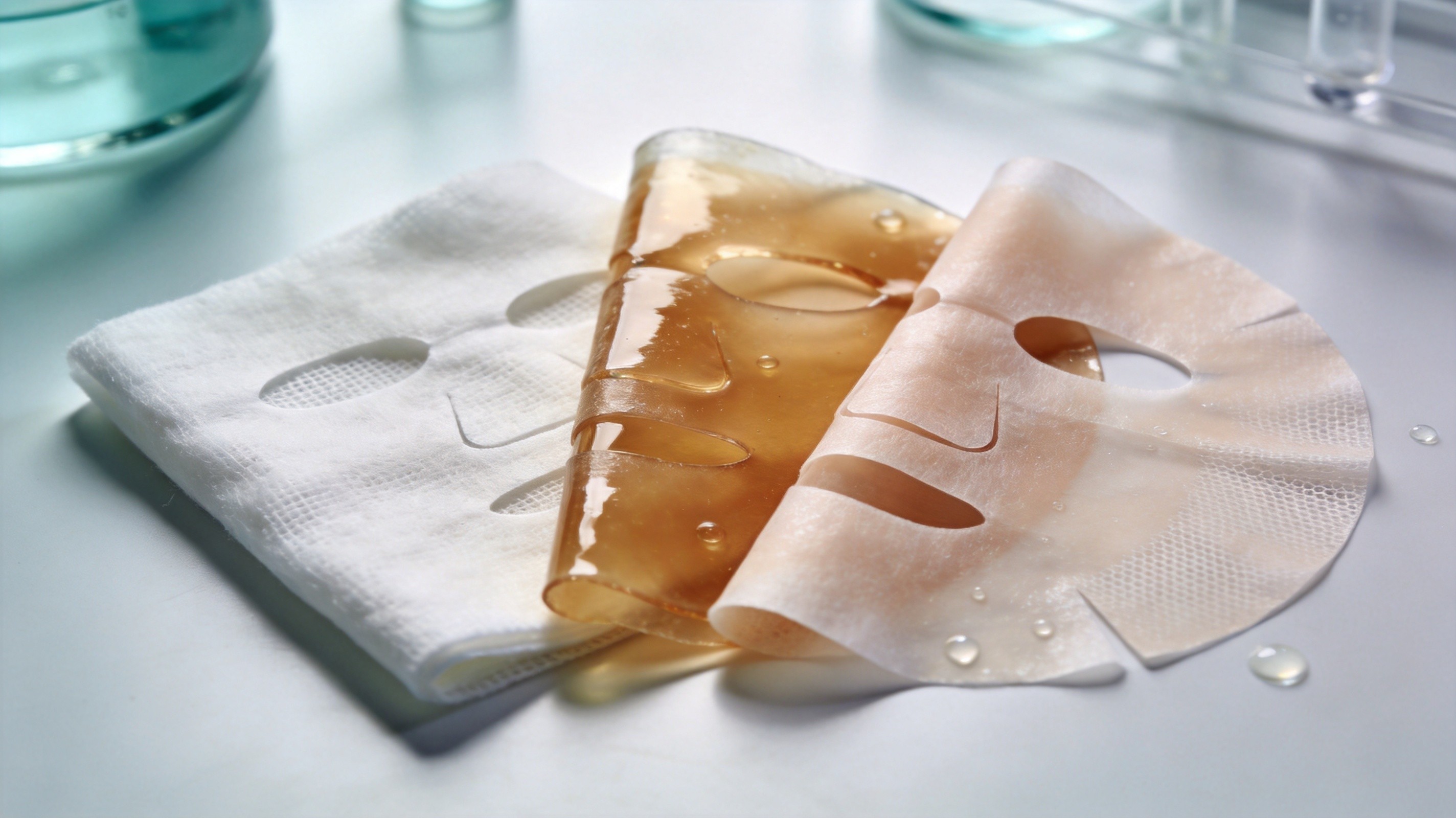
Non-woven masks are ideal for basic, high-volume lines; hydrogel masks facilitate the sustained-release of active ingredients; bio-cellulose masks offer the ultimate fit. When brands choose a material, they are essentially matching the ingredient carrier with profit margins.
Non-woven is the most common substrate on the market. Its advantages lie in a mature supply chain and low MOQ thresholds, making it suitable for new brands testing the waters. However, its large pores make the essence prone to dripping, and the fit is average. If you are only doing basic moisturizing, or pairing it with some conventional peptides for a daily care line, non-woven is completely sufficient. Its cost structure allows brands to reserve enough marketing budget at the retail end.
The substrate of a hydrogel mask is a polymer gel network. Its most notable feature is body-temperature sustained-release—after application, the gel opens its network upon heating and slowly pushes actives into the skin. This material has a naturally cooling and soothing feel, and it does not drip. If you plan to add a sufficient amount of Recombinant Type III Humanized Collagen or Elastin to the essence to make the skin look fuller and more hydrated, hydrogel is the most cost-effective carrier. Its visual presentation is also excellent; the transparent gel visible through the packaging usually leads to higher e-commerce click-through rates.
Bio-cellulose mask is a natural fiber fermented from coconut water. It is as thin as a cicada's wing and clings tightly to the face like a second skin, pressing every drop of essence into the skin texture. The fermentation cost of this material cannot be lowered, so both the unit price and MOQ requirements are relatively high. It is suitable as a brand's flagship product, carrying ingredients such as Recombinant Collagen Type I, Fibronectin, or Mussel Adhesive Protein. Used in professional salon lines or high-end anti-aging lines, the visual feedback of translucent, firm skin at the moment the customer peels it off is something non-woven cannot provide.
Core differences among the three materials:
Non-woven mask: essence capacity 20–25 ml, average fit, suitable for basic moisturizing and mass retail lines.
Hydrogel mask: essence capacity 25–35 ml, body-temperature sustained-release, suitable for advanced care with peptides and Recombinant Collagen.
Bio-cellulose mask: essence capacity 20–30 ml, ultimate fit, suitable for high-end salon and repair lines with Fibronectin, etc.
Q: Which material is safest for a new brand's first mask order?
A: Non-woven mask is the first choice. Its supply chain is the most mature, MOQs are flexible, and trial-and-error costs are low. Brands can first use non-woven with a basic peptide essence to get the sales process running, then upgrade the material once they have stable cash flow.
Q: Why does hydrogel mask cost more than ordinary non-woven?
A: Because the hydrogel substrate itself is a polymer, and the molding process is more complex. But it locks the essence firmly in the gel network, reducing drip waste, and the feel on the skin is cooler, supporting a higher retail price.
Q: Is the MOQ threshold for bio-cellulose masks really high?
A: Indeed, it is relatively high. Because bio-cellulose requires a specific fermentation cycle, and once the machine starts it cannot stop, factories usually require higher MOQs to amortize startup costs. It is more suitable for mature products that already have stable sales.
Q: Must expensive ingredients like Recombinant Collagen be paired with bio-cellulose?
A: Not necessarily, but hydrogel or bio-cellulose can maximize the user experience. Recombinant Collagen molecules are relatively large; the sustained-release properties of hydrogel and the strong pressing effect of bio-cellulose can make the skin look fuller, better than the simple soaking effect of non-woven.
Choosing the right material is only the first step; the essence formula is the soul. If you have a core ingredient you want to promote, or want to develop a new mask line, send us your requirements anytime. We will help you match the most suitable substrate and ingredient combination, directly provide a private label solution and quotation, and arrange sampling once you are interested.