Quick answers
If you only have thirty seconds, here is what our production floors can do for your brand.
We are an export-focused OEM/ODM manufacturer of cosmetic and related products. Our main platforms are freeze-dried (lyophilized) skincare, small-container liquid filling in vials, ampoules and bottles, microinfusion kit assembly, and cream-and-gel texture development. We fill, stopper and cap automatically or on semi-automated stations, assemble multi-piece kits and gift sets, insert leaflets and finish cartons for export. Every product is made under your own brand, and we stay behind the line as the manufacturer.
Why brands come to us
Buyers today want products that look technical, feel fresh and survive international shipping. They also want a partner who can do more than one thing, so a launch does not have to be split across several factories. We built our platforms to cover the fastest-growing export formats under one quality system — a freeze-dried core, a liquid companion, a microinfusion set or a cream range can all be developed to look like one family.
Platform one: freeze-dried skincare
What freeze-drying is
Freeze-drying, or lyophilization, freezes a prepared material and then dries it under vacuum, so water moves from ice straight to vapor without becoming liquid. The result is a lightweight, porous, dry structure — a soft fiber, a feather-light flocculent cloud or a wafer-like sheet. With the water removed, the texture stays dry and stable on the shelf and is reactivated with liquid at the moment of use.
On the floor
In the cleanroom, operators in full protective garments spread prepared material evenly across stainless steel trays and load them onto tiered shelves inside the freeze-drying chamber. Shelf after shelf carries the pale, airy dried material before it moves to downstream handling and packing.
Formats you can develop
• Freeze-dried fiber and cloud-like flocculent textures in small vials or jars
• Wafer-like sheets and masks made to rehydrate before application
• Pairing concepts with a dry core and a separate liquid activator
• Custom colors, layering and finishing to match your visual direction
These are cosmetic products. We talk about appearance, texture and the experience of use — helping skin look refreshed, hydrated and cared for — not medical or treatment results.
Platform two: small-container liquid filling
Automated filling, stoppering and capping
On the automated line, small glass vials move along a conveyor and are indexed through filling, stoppering and capping stations. A rotary starwheel positions each container so doses and closures are applied consistently. Clear and amber glass are both common, depending on the look you want and how the contents should be protected from light.
Semi-automated filling for flexibility
For smaller batches, special shapes or development work, operators run semi-automated filling and closing stations, checking weights and finishing units by hand. This gives new brands a lower-volume path to market and room to test before scaling up.
Cartoning and leaflet insertion
An automated cartoning line forms and fills boxes, inserts folded leaflets and closes the packs before outer packing. Clean finishing and documentation matter for brands selling into markets with clear labeling expectations.
What can be filled
The lines suit single-dose serums, ampoule-style products, small-bottle cosmetics and companion activators. Container, closure, carton and outer pack can all be tailored to your range.
Platform three: microinfusion kit assembly
Microinfusion-style sets are among the most asked-for concepts in beauty right now. A typical kit brings together small vials of liquid and a handheld applicator with a fine micro-needle or micro-stamp head, presented in a molded tray inside a finished box.
Our teams assemble these multi-piece sets on a manual production line, placing the applicator head and vials into fitted trays, checking each component and closing the pack. Because kits combine several parts, careful assembly and presentation are what separate a premium set from an ordinary one. We can build the set around your chosen applicator, bottle count, tray layout and outer box, developed as a cosmetic product and labeled for your destination market.
Texture development: creams, gels and serums
Texture is part of the product. On our development tables you can see creams and translucent gels in small jars, and how they pick up, spread and settle on the skin. We work with a range of feels — light and watery, bouncy and cushioning, rich and cushiony — so the texture matches the claim direction and price position of the line. Development samples are prepared for your review, then refined before production. As with all our cosmetics, descriptions stay with how a product looks and feels and how it helps skin appear, rather than promising medical effects.
Manual finishing and gift-set packing
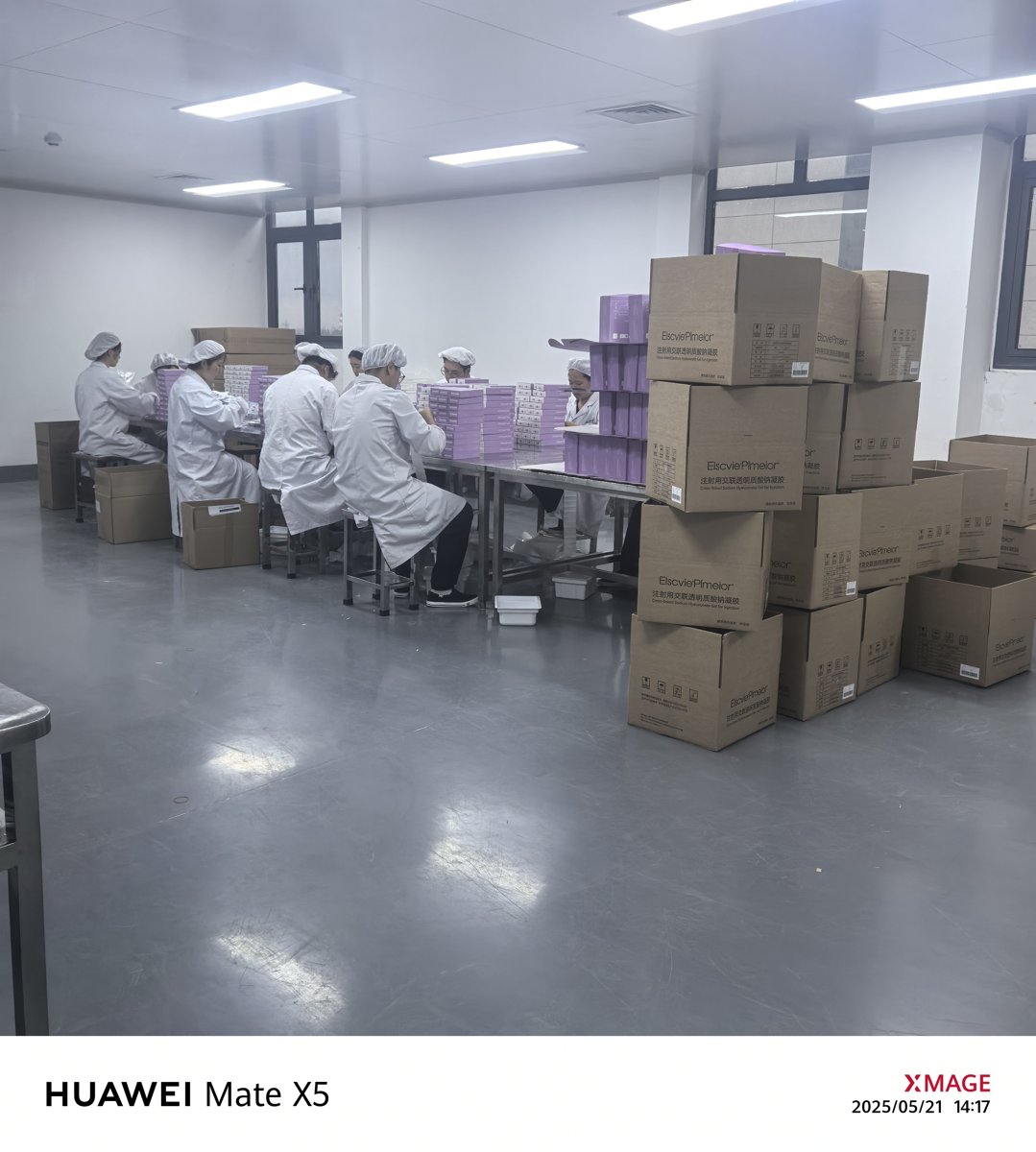
Not everything can be finished by machine. Our packing rooms handle hand assembly and gift-set work: operators collate components, arrange products in trays and boxes, add inserts and prepare finished sets for outer packing. This is how coordinated kits, limited editions and presentation boxes are produced to a consistent standard.
Quality and cleanroom discipline
Across every platform, operators work in protective garments, product-contact surfaces are stainless steel, and the floors separate clean preparation, filling, drying and finishing. Documented procedures cover receiving, preparation, filling, drying, packing and release, so each batch is made the same way and can be traced.
Research, patents and the showroom
Our showroom pairs product displays with a wall of patent certificates, reflecting ongoing work on formulations, textures and processing. For export partners this is practical: there is an in-house team to discuss texture and format